
Concrete floors carry the visible evidence of a facility's workload: forklift dust, tracked grit, dock soil, pallet debris, spills, tire marks, and residue from daily operations. Green Clean Janitorial helps facility managers keep concrete floors safer, cleaner, and easier to maintain with scheduled machine scrubbing, detail work, and realistic maintenance guidance.
Tell us your floor type, square footage, shifts, and traffic pattern. We respond same business day.
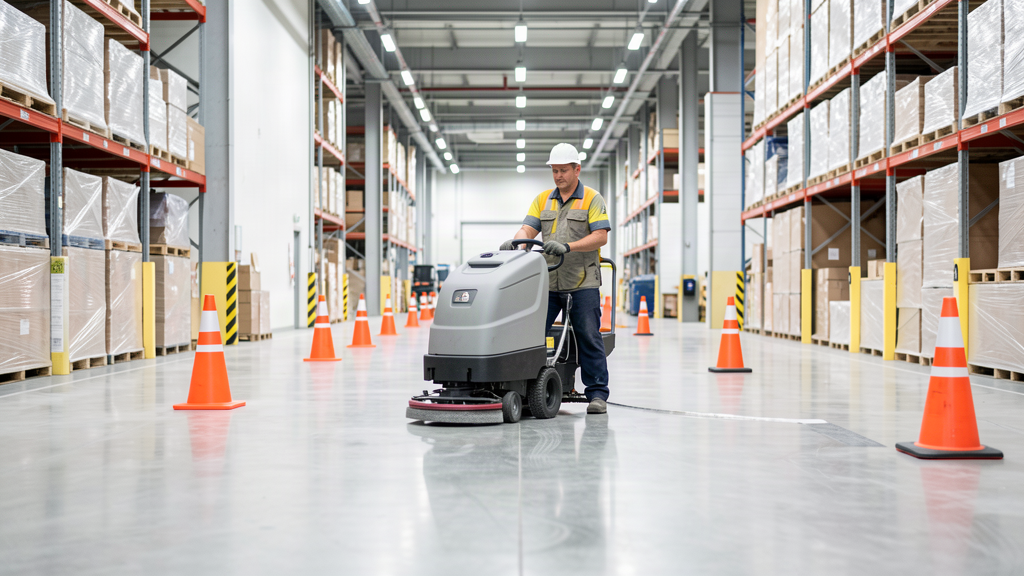
Image: commercial auto-scrubbing on a smooth concrete warehouse floor with safe work-zone setup.
Concrete floors are durable, but durability does not make them maintenance-free. A warehouse aisle, industrial shop, loading area, service corridor, or back-of-house concrete floor can collect fine dust, oils, tracked moisture, pallet fragments, rubber transfer, and winter salt. If the floor is only swept, the dust returns. If it is only mopped, the mop often spreads residue across a larger area. If it is scrubbed without the right recovery process, dirty solution can settle back into low spots and edges.
A useful concrete floor cleaning program starts by identifying the surface and the traffic. Is the concrete sealed, coated, polished, worn, broom-finished, or patched? Does it support forklifts, pallet jacks, carts, production equipment, employees, visitors, or vehicles? Is the goal appearance, dust reduction, slip-risk control, tenant satisfaction, audit readiness, or a cleaner work environment? Those answers determine the process and frequency.
Green Clean Janitorial typically starts with dry debris removal, edge checks, and a walk-through of drains, dock doors, storage zones, equipment, and safety constraints. The cleaning method may include auto-scrubbing, low-speed machine work, wet vacuum recovery, spot treatment, neutral cleaning, degreasing where appropriate, and follow-up detail for edges, corners, and traffic lanes. We schedule the work around operations so the floor has time to dry before normal traffic returns.
For many facilities, the service is not a one-time project. Concrete floor cleaning works best as a maintenance cadence. A warehouse may need weekly or biweekly auto-scrubbing in traffic lanes, monthly detail work at dock doors and corners, and periodic deep cleaning after seasonal salt, construction dust, inventory changes, or production surges. A shop may need spill-response rules and chemistry controls. A back-of-house area may need frequent cleaning because it sits between public and operational zones.
Warehouse operators often need cleaner aisles for safety, dust control, and better presentation during customer or leadership visits. Industrial and manufacturing plants need cleaning that respects production equipment, shift changes, and safety rules. Auto dealerships and service departments need floors that can handle tire marks, oil-adjacent soil, and customer visibility. Schools, churches, arenas, gyms, and multi-use buildings may have back corridors, storage rooms, mechanical areas, and service entrances where concrete floors affect the overall facility condition.
Concrete floor cleaning also supports other services. Cleaner concrete reduces the amount of grit tracked into carpet, VCT, tile, entrances, restrooms, and office corridors. That helps protect commercial floor care, carpet cleaning, tile and grout cleaning, and recurring janitorial work.
First, we walk the floor with the facility manager or site contact. We note square footage, floor condition, work zones, power or water access, drains, equipment, traffic windows, safety requirements, and problem areas. Second, we identify whether the floor needs routine scrubbing, deeper recovery cleaning, edge detail, spill-area attention, or a different day-to-day maintenance method. Third, we build a schedule that works around shifts, deliveries, tenants, school hours, patients, customers, or production needs.
Finally, we document what the scope includes and what it does not. Concrete with permanent staining, damaged coating, heavy oil saturation, failing sealer, or structural issues may not return to a like-new appearance through cleaning alone. We call that out upfront. The goal is to give you a floor that is cleaner, safer, more presentable, and easier to maintain, not to make claims the surface cannot support.
Track floor condition by zone. Dock doors, shipping aisles, breakroom approaches, restrooms, entrances, production cells, and service corridors rarely soil at the same rate. If the whole building is cleaned on one interval, some areas are over-serviced while the highest-impact zones still fail. A zone-based schedule usually performs better and costs less than guessing.
Ask your cleaning vendor how often the floor is dry-swept, when it is machine scrubbed, how dirty solution is recovered, how edges are handled, what happens after spills, and what interval is recommended for high-traffic lanes. If the answer is only “we mop it,” the floor probably needs a stronger plan. Green Clean Janitorial can build that plan into warehouse floor care, industrial cleaning, or a broader recurring janitorial program.
Request a walkthrough. We will review traffic, surface type, cleaning interval, safety constraints, and realistic outcomes before quoting.
Tell us about your facility. We respond same business day.