
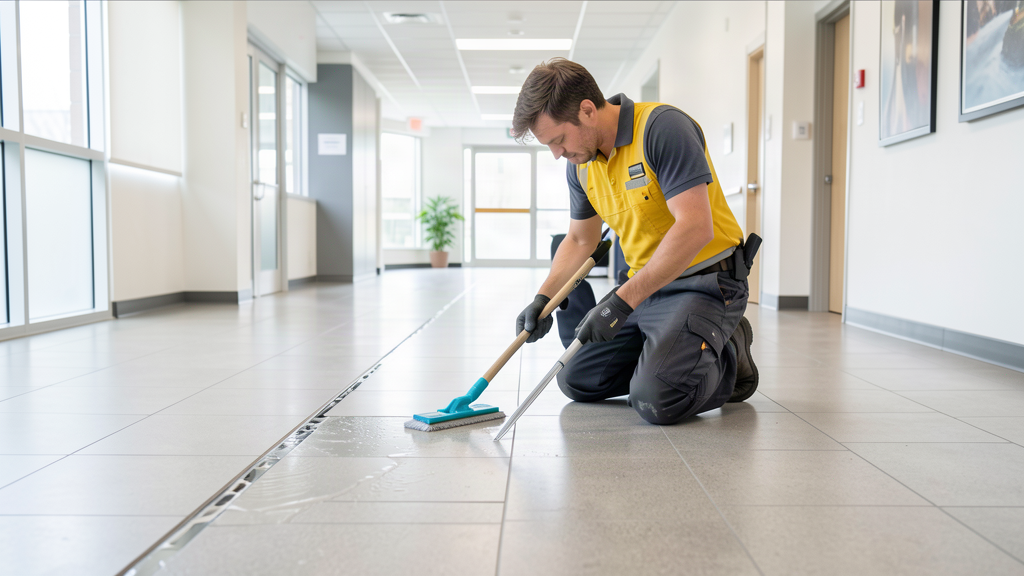
Commercial hard floors do not all need the same cleaning frequency. A front entrance, restroom tile floor, warehouse concrete aisle, VCT hallway, clinic corridor, and office breakroom can all be in the same building and still require different maintenance intervals. The right question is not “how often should floors be cleaned?” The better question is “what type of floor is it, how is it used, what soil does it collect, and what condition must it hold during business hours?”
This guide gives facility managers a practical way to set hard floor cleaning frequency without guessing. It supports Green Clean Janitorial’s commercial floor care, warehouse floor care, commercial tile and grout cleaning services, and commercial concrete floor cleaning services.
Start with floor type and traffic pattern
Hard floor cleaning frequency should be based on floor type, traffic, soil source, safety requirements, and presentation standard. VCT needs finish protection. Tile and grout need grout-line maintenance. Concrete needs dust and residue control. Restroom floors need odor and moisture management. Entry floors need grit and weather response. A generic nightly mop may be enough for a low-traffic office corridor, but it will not hold up in a clinic restroom, school entry, warehouse aisle, or industrial shop.
During a walkthrough, divide the building into entrances, restrooms, breakrooms, corridors, production areas, warehouse aisles, docks, stairs, elevators, and public-facing spaces. Each zone should have a maintenance frequency that matches how it fails.
Daily or nightly hard floor tasks
Most commercial buildings need some level of daily or nightly hard floor maintenance. This usually includes dust mopping, spot mopping, damp mopping, removing visible debris, cleaning spills, checking entrances, and addressing restroom floors. In offices, this may be enough for low-traffic areas. In medical offices, schools, gyms, dealerships, churches, and multi-tenant buildings, daily work often needs tighter supervision because public-facing floors affect trust.
Daily tasks should not be confused with deep cleaning. A nightly mop can remove fresh soil, but it usually cannot remove embedded grout discoloration, compacted finish buildup, concrete dust in low spots, salt residue, or old detergent film. If a hard floor looks clean only for a few hours after service, the maintenance interval or method is probably wrong.
Weekly and biweekly machine cleaning
High-use hard floors often need machine cleaning weekly or biweekly. This can include auto-scrubbing concrete, machine scrubbing tile, buffing or burnishing VCT finish, and detail work along edges and corners. Warehouses, industrial plants, schools, gyms, large offices, clinics, and event facilities are common candidates.
Machine cleaning matters because it adds agitation, consistent solution control, and better soil recovery than mopping. It is especially useful where traffic lanes start looking darker than surrounding areas. If you can see a path where people, carts, or forklifts travel, the floor is telling you the frequency is too light or the process lacks machine work.
Monthly, quarterly, and seasonal deep cleaning
Monthly or quarterly deep cleaning keeps hard floors from slowly declining. Tile and grout may need periodic scrub and rinse work. Concrete may need lane scrubbing, edge recovery, and dock-area detail. VCT may need scrub-and-recoat or burnishing cadence before a full strip and wax is necessary. Restroom floors may need edge detail, drain checks, odor-source treatment, and fixture-area attention.
Seasonality also matters. Winter salt, rain, pollen, construction dust, inventory moves, school breaks, event seasons, and production changes can all create short-term soil loads. A facility that is easy to maintain in May may need a stronger plan in January or during a construction project.
Suggested frequency by floor and area
Use these as starting points, not universal rules: office hard floors usually need nightly dust or damp mopping plus monthly or quarterly machine cleaning; restroom tile usually needs nightly cleaning, weekly edge detail, and quarterly grout review; warehouse concrete may need weekly, biweekly, or monthly auto-scrubbing; VCT corridors need routine dust control, burnishing, and scrub-and-recoat or strip-and-wax before finish failure.
The best schedule is usually zone-based. One building may need weekly auto-scrubbing in warehouse aisles, quarterly tile and grout cleaning in restrooms, monthly entry machine cleaning, and routine nightly mopping in private office areas.
Signs your current floor cleaning frequency is too low
The most obvious sign is visible traffic lanes. Other signs include dark grout lines, recurring restroom odor, sticky floors, dull VCT, concrete dust returning quickly, tenant complaints, salt residue near entrances, scuffs that never disappear, or edges and corners that look worse than open areas. If floors look acceptable immediately after cleaning but fail by mid-day, the building may need daytime checks or a different process in high-use zones.
If floors look poor even first thing in the morning, the nightly service or periodic machine work is not keeping up. If only certain zones fail, do not increase cleaning everywhere. Increase frequency where the floor actually needs it.
How Green Clean Janitorial builds a hard floor schedule
Green Clean Janitorial starts with a walkthrough, not a generic square-foot price. We review floor types, traffic, shifts, public areas, safety constraints, soil sources, and complaint history.
For example, a warehouse may need commercial concrete floor cleaning every two weeks in traffic lanes, monthly dock detail, and nightly debris removal. A clinic may need restroom tile detail, public corridor machine cleaning, and nightly disinfection. An office building may need entry floor recovery during winter and scheduled VCT burnishing. A multi-use property may need several intervals in one contract.
Questions to ask before changing vendors
Before replacing a cleaning vendor, ask whether the problem is frequency, process, supervision, chemistry, or surface condition. A good floor review should identify the floor types, which zones fail first, what time of day floors become unacceptable, whether machine work is included, and whether the issue is cleanable soil, damaged finish, staining, or a repair problem.
Those answers create a better scope and prevent paying for more service in areas that are already fine while the real problem remains unchanged.
Bottom line
Commercial hard floors should be cleaned as often as needed to hold the building’s safety, appearance, odor, and operational standards. For many facilities, that means daily maintenance plus weekly, monthly, or quarterly machine work in the zones that carry the most traffic. If a floor is always dull, dusty, sticky, or discolored, the issue is usually not effort; it is the wrong frequency or method.
Green Clean Janitorial can walk your building, separate routine janitorial from periodic hard floor care, and create a schedule for concrete, tile, grout, VCT, entries, restrooms, and warehouse areas. Request a quote through the contact page or call 877-737-3030.
Should commercial hard floors be mopped every day?
Many occupied commercial floors need daily or nightly spot mopping, damp mopping, or dust control. High-traffic areas may also need daytime checks and scheduled machine cleaning.
How often should commercial tile and grout be deep cleaned?
Most commercial tile and grout should be deep cleaned quarterly to twice per year, with restrooms, clinics, schools, gyms, and entries evaluated more often based on odor, moisture, and traffic.
How often should warehouse concrete floors be auto-scrubbed?
Warehouse concrete may need auto-scrubbing weekly, biweekly, or monthly depending on forklift traffic, dock activity, dust, spills, and appearance or safety requirements.
Is burnishing the same as deep cleaning?
No. Burnishing restores gloss to existing floor finish, usually on VCT. Deep cleaning removes embedded soil, residue, or buildup and may include scrubbing, extraction, rinse recovery, or restorative work.